
In healthcare, building an AI experience is only the beginning. The more consequential challenge is determining whether it can be trusted at the moment a patient, trainee, or clinician needs it. That means moving beyond impressive demonstrations to address the requirements of real-world implementation: grounding responses in validated knowledge, reducing the risk of hallucinations, making output auditable, earning clinician trust, and testing the experience with the people it is intended to support.
These questions were at the center of the Mayo Clinic AI Research Summit, where researchers, clinicians, educators, and technology leaders gathered to explore how AI modeling and simulation can generate clinically meaningful evidence and improve care.
In the summit keynote, Mayo Clinic Chief AI Implementation Officer Micky Tripathi emphasized the need to turn AI research into responsible action. neuRealities extended that conversation through a fireside chat, an interactive workshop, and an education table featuring two production-stage AI Experts co-developed with Mayo Clinic.
Two AI Experts designed for moments of need
During the fireside chat, “Scaling Trusted Expertise at the Speed of Need,” panelists explored two very different applications united by the same goal: making trusted knowledge available when and where it can have the greatest impact.
Supporting patients between diagnosis and treatment
The Breast Cancer Patient Education AI Expert is designed to support newly diagnosed patients during the often-overwhelming period between diagnosis and their first appointment. Through an empathic, voice-enabled experience available 24/7, patients can access education grounded in Mayo Clinic knowledge and engage with information at their own pace. The experience is intended to help patients feel better informed and prepared while complementing—not replacing—their care team.
Bringing anatomy expertise to the point of learning
The Clinical Anatomy AI Expert gives trainees real-time, hands-free access to anatomy guidance in the lab and at the point of care. Built using custom-narrated dissection footage and expert-developed knowledge, the experience allows learners to explore complex anatomy in context. Instead of searching through conventional resources, trainees can engage with relevant guidance while actively learning or preparing for a procedure.
What trusted AI requires in healthcare
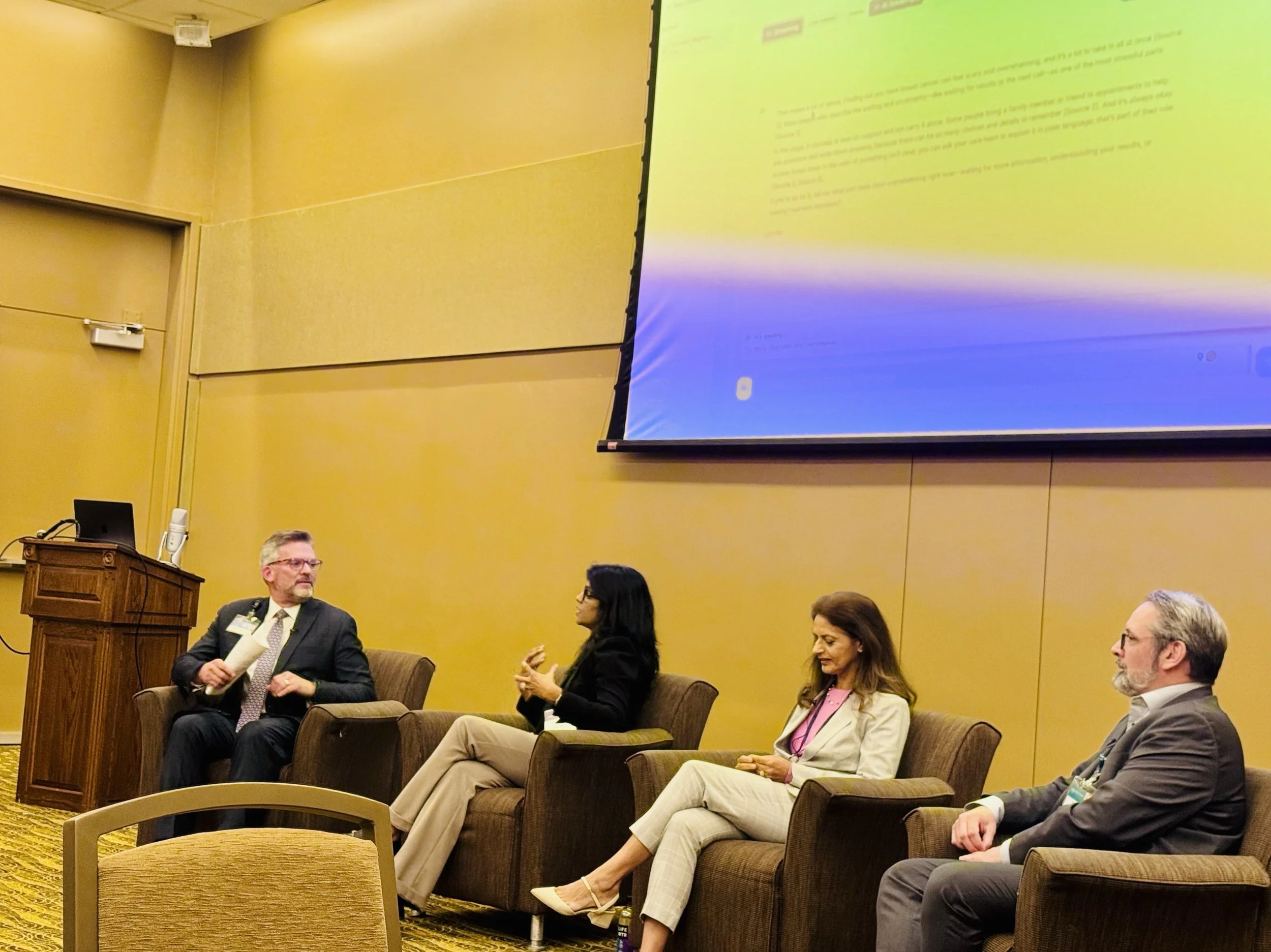
Fireside Chat with Bob Morreale, moderator, and panelists Dr. Lachman, Dr. Pruthi, and Dan Donovan. (Left to Right)
The fireside chat brought together Dr. Sandhya Pruthi, Professor of Medicine, Division of General Internal Medicine/Breast Diagnostic Clinic, Mayo Clinic; Dr. Nirusha Lachman, Professor of Anatomy and Professor of Medical Education, Mayo Clinic; and Dan Donovan, Head of AI, neuRealities. Bob Morreale, Senior Division Chair in Mayo Clinic’s Department of Education, moderated the conversation.
Together, the panel examined what it takes to deploy deterministic, hallucination-resistant AI in a setting where accuracy, transparency, and auditability are essential. Unlike a general-purpose large language model that generates an answer based primarily on probability, a deterministic AI experience operates within defined knowledge, rules, and workflows. This helps ensure that its responses can be traced to approved source material and evaluated against established standards.
For healthcare applications, that distinction matters. Trust cannot depend solely on whether an answer sounds convincing. It must be supported by how the response was produced, what knowledge informed it, and how the experience performs under rigorous review.
Moving from demonstration to validation
Following the fireside chat, neuRealities hosted a hands-on workshop and education table where researchers, clinicians, educators, and students could interact directly with the AI Expert experiences. The conversations reinforced several principles that are shaping our work:
Trust must be built into the system. Grounding AI in defined knowledge and rules makes responses more consistent, explainable, and auditable.
Validation must reflect real-world use. Both AI Experts are progressing through structured, multi-phase protocols that include subject-matter expert review, clinician red-teaming, and patient or trainee pilots.
Human expertise remains central. The most valuable healthcare AI experiences augment the judgment, empathy, and knowledge of people; they do not replace them.
Context determines value. Scaling trusted expertise means making the right knowledge available at the precise moment it is needed—whether that is in a patient’s living room, an anatomy lab, or a clinical environment.
Building AI worthy of healthcare
We are grateful to Mayo Clinic for inviting neuRealities to participate in the AI Research Summit and to Dr. Pruthi, Dr. Lachman, Bob Morreale, and the Mayo Clinic Education team for continuing to build and learn alongside us. Our goal is not simply to build AI. It is to develop trusted AI experiences that improve learning, preparedness, and access to expertise while meeting the rigorous standards that healthcare demands. Because in healthcare, the measure of AI is not only what it can do. It is whether people can trust it when it matters.