
Healthcare Doesn’t Need Another Chatbot. It Needs Trusted AI Experts.
Healthcare has no shortage of expertise. It has a shortage of scalable access to it.
Critical knowledge is often concentrated among a limited number of clinicians, educators, and subject-matter experts, and dispersed across curricula, clinical resources, and disconnected institutional systems. As a result, learners, clinicians, patients, and caregivers may not be able to access it when a question arises or a decision must be made.
Generative AI appears to offer a solution. But in healthcare, a fast answer is not enough. It must also be grounded, traceable, current, and appropriate to the context in which it is used. That is the difference between a general-purpose chatbot and what we believe an AI Expert should be.
An AI Expert Should Verify Before It Generates
Most generative AI systems produce a plausible response and then, when possible, support it with retrieved information. For many everyday applications, that may be sufficient. For healthcare and medical education, it is the wrong order of operations. At neuRealities, our position is clear: AI should verify before it generates—not generate first and verify later. Our AI Experts are designed around rules before language. Rather than allowing a language model to improvise, the platform grounds each interaction in approved institutional knowledge and engineered rules. Responses are designed to be:
Based on verified source materials
Traceable to supporting evidence
Consistent with institutional standards
Auditable for healthcare governance
Delivered in real time, at the moment of need
No guessing. No drift. No improvisation presented as fact.
This logic-first approach becomes even more important as AI grows more humanlike. A natural voice or realistic digital presence may make technology engaging, but appearance cannot substitute for authority. An AI Expert must be more than visual-first. It must be grounded in trusted knowledge from the inside out.
Scaling the Teacher-Apprentice Model
Medical education demonstrates why this matters. Clinical anatomy has traditionally relied on a teacher-apprentice model in which learners gain knowledge through direct interaction with experienced faculty. That relationship remains invaluable, but it is constrained by faculty availability, geography, class size, and competing responsibilities. AI should not replace that relationship. It should extend its reach.
The Clinical Anatomy AI Expert, developed in collaboration the Mayo Clinic, explores what becomes possible when trusted educational knowledge is available through an always-on, conversational experience.
At the American Association of Clinical Anatomists’ 43rd Annual Conference, teaching faculty, researchers, program directors, and clinical educators gathered in Rochester, Minnesota. Attendees interacted directly with the neuRealities Clinical Anatomy AI Expert, asking questions by voice, exploring contextual diagrams, and reviewing source-backed references grounded in Mayo Clinic’s verified educational materials. The goal is not simply faster information retrieval. It is contextual learning: delivering the right knowledge, supported by the right source, when it can be understood and applied.
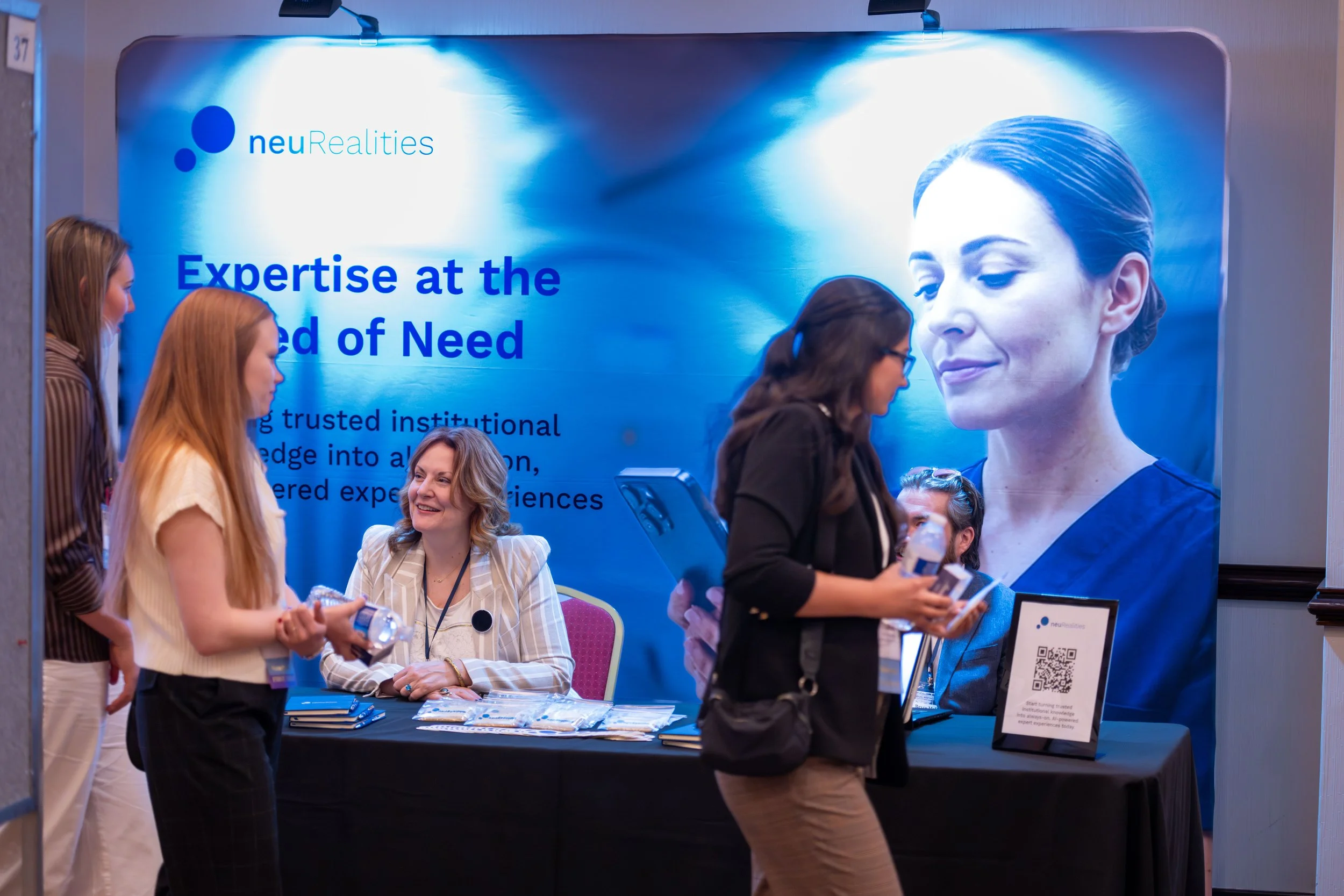
neuRealities at the AACA Annual Conference. Photo credit: Mayo Clinic.
Augmenting Experts, Not Replacing Them
The best use of AI in healthcare is not to remove people from education or care. It is to reduce the burden on experts while preserving the human relationships that matter most. An AI Expert can answer recurring questions, reinforce foundational concepts, and let learners explore a subject at their own pace. Faculty can then devote more time to work requiring judgment, experience, mentorship, and creativity.
The same principle extends beyond anatomy. A trusted AI Expert could support patient education between appointments, make operational knowledge available to clinical teams, or help organizations preserve specialized expertise as workforce demands grow. The larger opportunity is not automating expertise. It is amplifying its impact.
A Higher Standard for Healthcare AI
These ideas shaped the Fireside Panel hosted during the annual meeting, moderated by Bob Morreale, Division Chair of Immersive and Experiential Learning at Mayo Clinic. The discussion brought together Dan Donovan, Head of AI at neuRealities; Walter Greenleaf, PhD, a behavioral neuroscientist and medical technology developer at Stanford University; and Derrick Connell, former Corporate Vice President of Search and AI at Microsoft. Their conversation addressed an urgent question: What separates a useful healthcare AI Expert from a chatbot with a medical veneer? The answer is not the fluency of the interface. It is the integrity of the system underneath it.
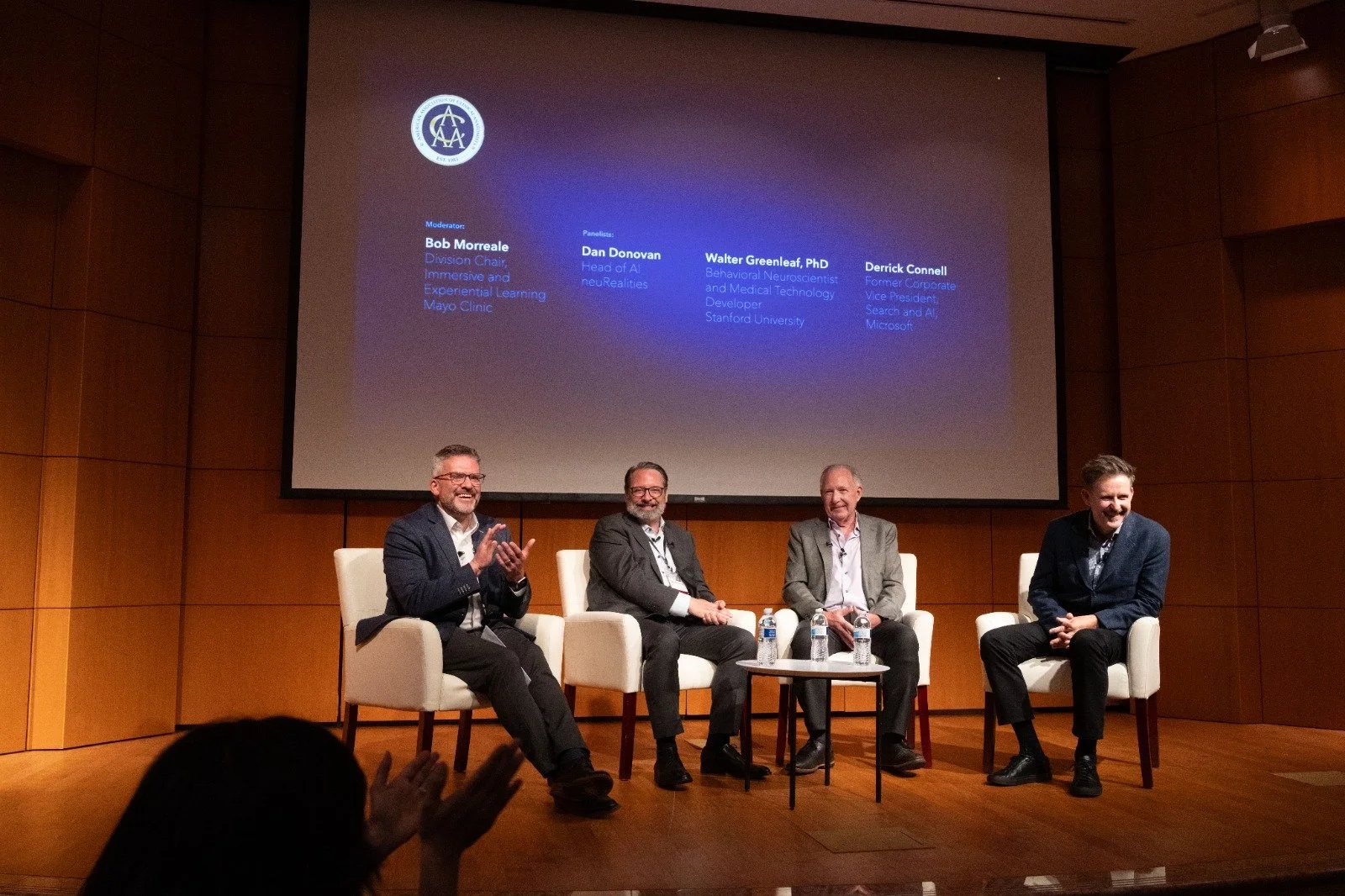
Fireside Panelists at the AACA Annual Meeting.
During AACA’s inaugural Vendor Showcase, Bryce McDonald, Senior Technical Program Manager at neuRealities, connected that principle to the healthcare workforce challenge. When knowledge remains locked in documents, departments, and the schedules of a limited number of people, it cannot meet demand at scale. Trusted AI Experts can make it more accessible without abandoning the governance, accuracy, and human oversight healthcare requires.
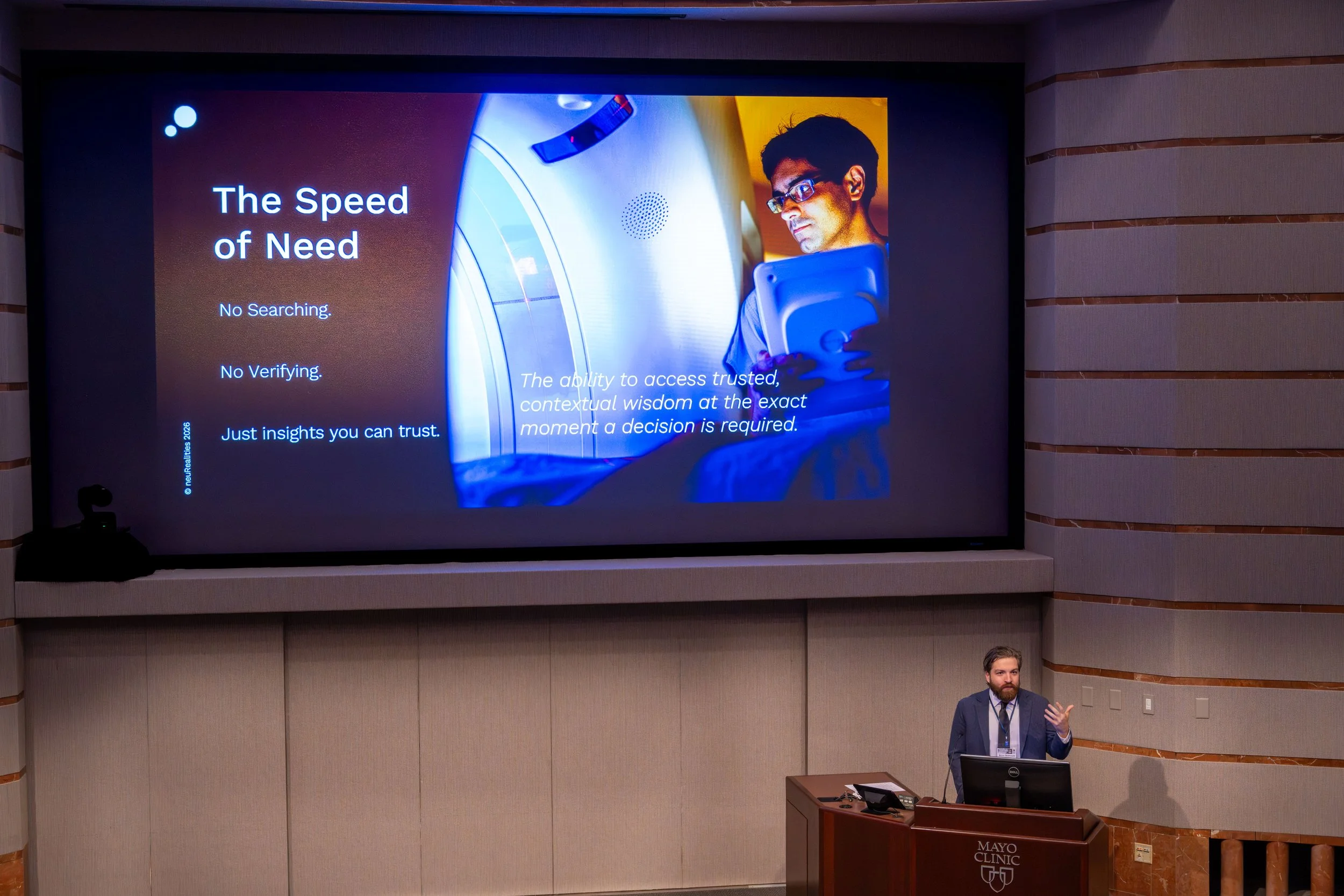
Bryce McDonald, Senior Technical Program Manager, speaking at the AACA Inaugural Vendor Showcase. Photo Credit: Mayo Clinic.
Healthcare leaders are not looking for AI simply because it is new. They are looking for responsible ways to expand access to trustworthy knowledge while improving learning, preparedness, and the human experience of care. Expertise should not be limited by geography, staffing, or scheduling. It should be available at the speed of need—and remain worthy of trust.
Want to explore how a trusted AI Expert could extend your organization’s knowledge? Connect with our team to experience the Clinical Anatomy AI Expert and learn more about the neuRealities platform.